In an incident that sent shockwaves across West Africa, the bustling Kantamanto Market in Accra, Ghana, endured a catastrophic fire on January 2. According to local authorities and multiple Ghanaian news outlets, the blaze erupted in the quiet hours of the morning, rapidly consuming thousands of shops and leaving countless families in distress. Reports indicate that more than 7,000 market stalls were destroyed, affecting upwards of 30,000 traders who rely on the market as their primary source of income.
Tragically, the fire claimed the life of one individual and left at least 14 others injured, according to Accra Metropolitan Assembly officials who responded to the scene. Eyewitness accounts described a night filled with chaos and heartbreak, as traders and emergency responders struggled in vain to salvage goods amid the spreading flames. For many vendors—predominantly women who form the backbone of the market’s informal economy—the disaster has cast uncertainty over their means of survival, forcing families to grapple with immediate financial hardship and long-term questions around recovery.
In the aftermath of this tragedy, acts of empathy and solidarity have begun to emerge, with local leaders and advocates stepping forward to support Kantamanto’s traders. Among them is Naana Arthur Donkor, a social entrepreneur known for her advocacy on behalf of small business owners in Ghana and the broader West African region. During a visit to the devastated market, Donkor took time to speak directly with clusters of affected vendors. She listened to accounts of loss—the goods reduced to ashes, the dreams deferred, the financial burdens now multiplying.
Moved by the hardship she witnessed, Donkor addressed the crowd, offering heartfelt words of encouragement while acknowledging that recovery would require collective effort. “This is not just the loss of wares; it’s the loss of livelihoods, of hope for many families,” she is reported to have said, according to several local radio stations in Accra. Her engagement did not end there. Determined to catalyze broader support, Donkor promptly announced the launch of a public fundraiser to rally assistance from individuals, businesses, and institutions across Ghana and beyond.
In a video shot amidst the ruins—surrounded by the somber faces of market women and families—Donkor appealed directly to the nation. She urged Ghanaians, fellow West Africans, and international well-wishers to contribute towards the relief effort, emphasizing the ripple effects this tragedy could have, both locally and across regional trade networks.
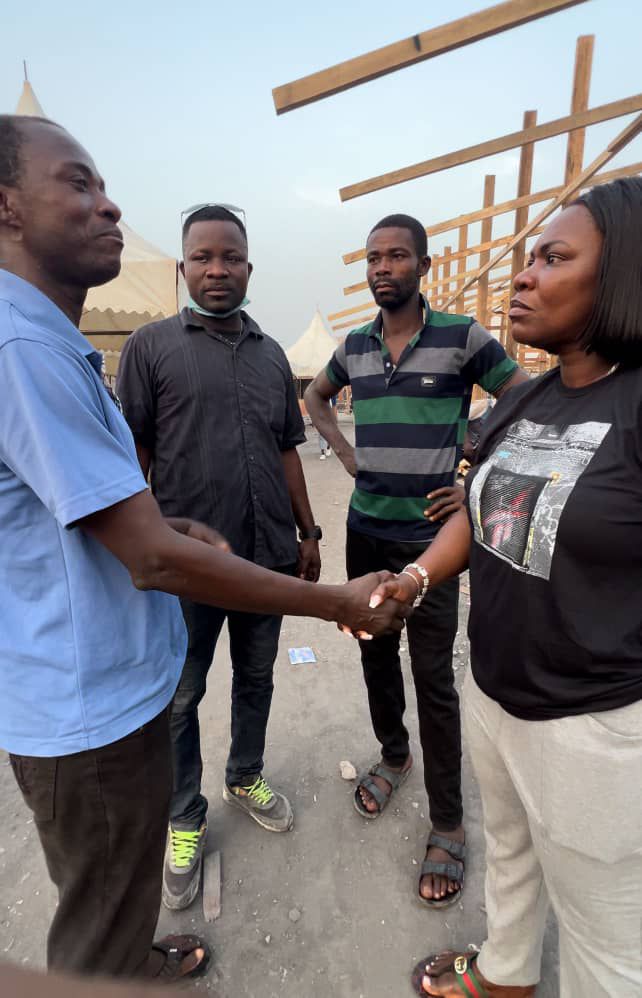
Kickstarting the fundraising initiative, Naana Arthur Donkor herself donated GH₵2,000 (approximately N160,000 at the prevailing exchange rate). She emphasized that while her contribution was modest given the scale of the need, it was a clarion call for others—including governments, NGOs, and ordinary citizens—to join hands. “In moments like these, we must look out for one another. Healing and rebuilding require everyone’s commitment,” Donkor remarked in her publicly shared statement.
Her efforts quickly gained support. Several prominent Ghanaians, business groups, and local churches reportedly indicated willingness to contribute, according to Ghana News Agency reports. There was also significant discussion about the role West African regional bodies—including ECOWAS—could play in supporting Ghana through disaster relief and market reconstruction efforts, given the cross-border importance of the Kantamanto Market for informal trade among Nigerian and Ivorian merchants.
Community organizers and market association leaders echoed Donkor’s sentiments, calling for transparent distribution of aid and collaboration with local governments to ensure resources reach those most affected. Mrs. Efua Asiedu, President of the Kantamanto Traders Association, stated, “We are grateful for every show of solidarity, but what we need most is a coordinated plan to rebuild—not only our stalls but also the safety mechanisms that can prevent future tragedies.”
Fire outbreaks in major West African markets are a recurring threat, often attributed to faulty electrical wiring, congested layouts, and lack of adequate emergency response systems. Nigerian markets, including the popular Balogun Market in Lagos and New Market in Onitsha, have faced similar disasters in recent years, with devastating impacts for local economies and supply chains. Analysts point out that in both cases, the massive scale of informal trading and limited access to insurance leave many SMEs—especially female traders—highly vulnerable.
According to Lagos-based economist Dr. Chidi Nwosu, “Kantamanto Market is not just a Ghanaian asset—it is a vital node in the West African trading ecosystem.” Dr. Nwosu noted that hundreds of Nigerian traders regularly purchase textiles and wares from Kantamanto, underscoring the interconnectedness of markets across borders. “A disaster of this scale doesn’t respect boundaries—it affects livelihoods in Nigeria, Côte d’Ivoire, Togo, and beyond.”
International humanitarian organizations—such as the Red Cross and the International Organization for Migration—have reportedly offered to assist in the recovery process, working alongside local agencies to provide temporary shelters and essential supplies. Meanwhile, the Ghana National Fire Service has promised a thorough investigation into the cause of the fire, with plans to advocate for improved safety standards and infrastructure upgrades in marketplaces throughout Accra.
The road to recovery remains uncertain. Many traders are still awaiting news about possible compensation or microcredit windows to restart their businesses. Ghana’s Ministry of Trade and Industry confirmed they are in talks with local banks to expedite affordable loans—a move that echoes calls made in Nigeria after similar market disasters. However, there are concerns about the effectiveness and reach of such interventions, particularly for traders without formal documentation or collateral.
Against this backdrop, Naana Arthur Donkor’s fundraising campaign has become a rallying point, described by the Ghanaian Times as a “timely effort in a period of deep grief.” The campaign acts as both a platform for immediate relief and a reminder of the need for longer-term solutions to market safety and trader welfare across the region. Donkor’s emotional appeal, amplified by her presence at the scene and shared widely on social media, has reminded Nigerians and Ghanaians alike about the enduring value of solidarity and community.
As victims work toward reclaiming their livelihoods, the Kantamanto fire serves as a sobering reminder for policymakers across West Africa: the resilience of informal traders is immense, but so are the challenges they face in the aftermath of disaster. For many market women, what is at stake is not just their business, but the education of their children, the health and stability of their families, and the future of intergenerational trade.
Efforts are underway to restore hope, rebuild infrastructure, and create a more secure trading environment. The conversation, however, is also shifting toward prevention—how can authorities and market leaders collaborate to minimize risks? How can regional trade policies be adjusted to offer better protection for market traders across Nigeria, Ghana, and West Africa?
The tragedy at Kantamanto Market stands as a call to action for communities, governments, and development partners throughout Africa and the global south. Whether by donating, advocating, or sharing stories of resilience, everyone can play a part in helping affected families recover and thrive again.
What are your thoughts on how West African countries can better protect informal traders from disasters like the Kantamanto fire? Have you or someone you know been impacted by a similar incident? Drop your comments below and follow us for the latest updates on this story and more breaking news from across Africa.
For general support, reach out at [email protected].
Connect with us for more real-life updates: Facebook, X (Twitter), and Instagram.
Your story could make a difference!