

In West Africa, gaining admission into a reputable secondary school represents a critical milestone for countless families, paving the way for future academic and career opportunities. Ghana’s Computerised School Selection and Placement System (CSSPS) stands out as one of the region’s most advanced and transparent school placement platforms. In a transformative move for the 2024/2025 academic year, Ghana’s Ministry of Education has rolled out sweeping changes, claiming to eliminate financial barriers and improve openness in student placement. These developments are drawing the attention of parents, educators, and policymakers in neighbouring Nigeria and across Africa, where calls for deeper educational reforms continue to grow.
Major Changes Arrive for 2024/2025: Nigerian & African Families Take Note
For the first time, Ghanaian and West African students can reportedly check their secondary school placement results entirely free, according to the Ministry of Education and the Ghana Education Service. The removal of voucher code fees – a longstanding cost that often disadvantaged lower-income families – signals a step toward greater inclusivity. Families and candidates will no longer be expected to purchase e-voucher codes to access placement information, marking a significant shift towards equitable education access.
MUST READ: 16 Strangest Festivals in The World That You Won’t Believe Exist
How to Check Your School Placement: Plain Guide for Students and Parents
Method 1 — Using the Official CSSPS Website
-
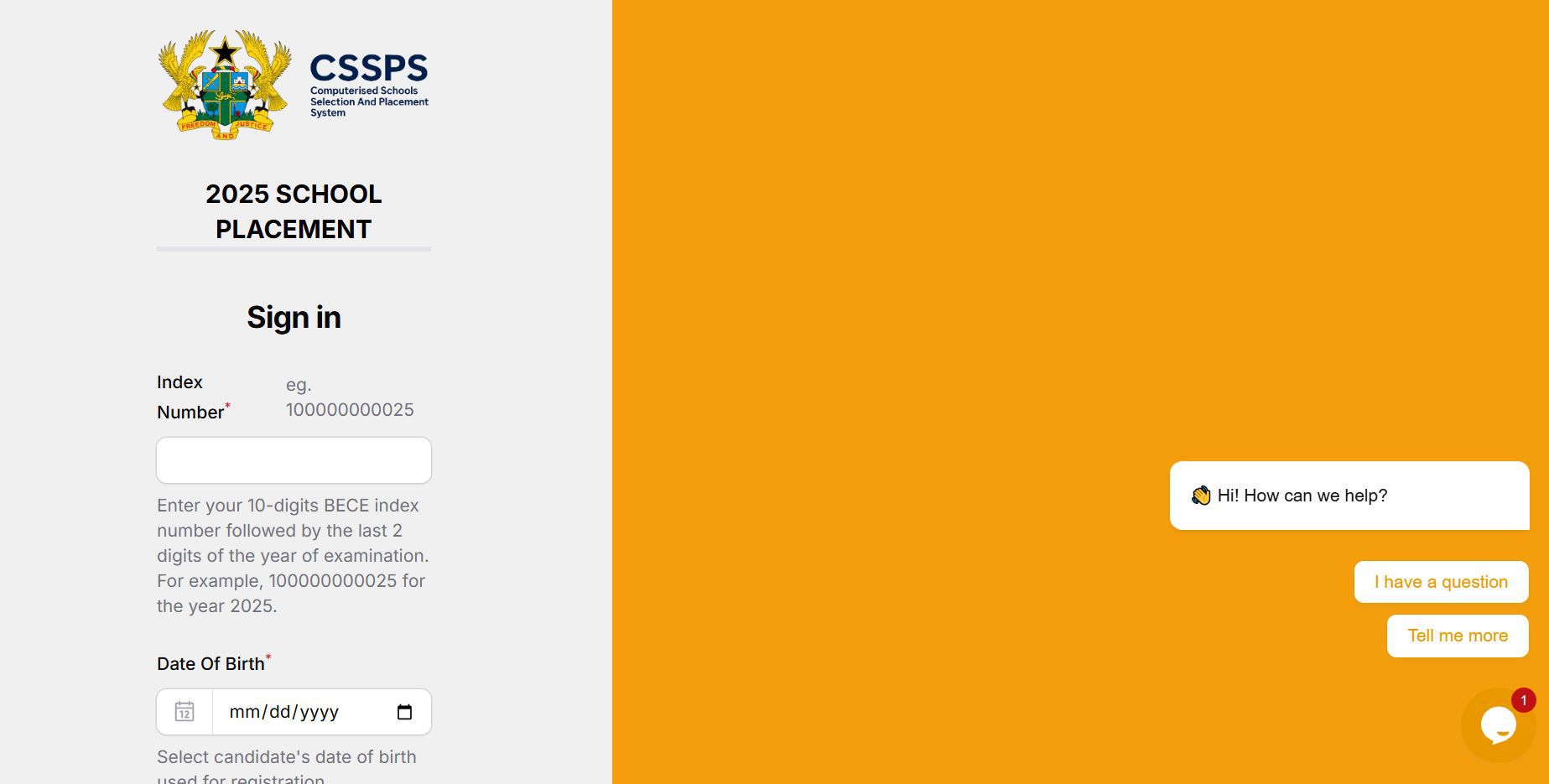
Begin by visiting the official site: www.cssps.gov.gh.
-
Prepare the required details:
-
Type in your 10-digit BECE index number, immediately followed by the last two digits of your completion year.
-
Example: If your index number is 1234567890 and your completion year is 2024, you would enter “123456789024.”
-
Be ready to input your date of birth if the platform requests further verification.
-
Hit the Submit button: Once you submit, your placement details will be displayed if you have been matched to a school automatically.
Method 2 — Access Through CSSPS Hub Portal
Alternatively, students can check placements at the Hub Portal via www.cssps.gov.gh/hub/login. This digital gateway promises round-the-clock secure access, a feature that might serve as an example for Nigeria’s own state and national placement systems that often struggle with peak-period congestion.
If You Are Not Automatically Placed
For candidates who are not matched to any school through the initial automated placement, the solution is the Self-Placement Portal found at sp.cssps.gov.gh:
-
Login using your index number and completion year (such as “123456789024”).
-
Scan through available schools and programmes with open slots, then make your selection.
-
Confirm your preferred option and print a copy of your placement slip for documentation.
Note: Checking your placement status is entirely free. However, according to the Ministry of Education, some optional self-placement processes may still require an e-voucher depending on the service in question.
Transparency in Placement: What Do the Results Mean?
Grade ‘A’ Schools: Top-tier or “Grade A” schools remain highly coveted and extremely competitive. Even students with excellent results may not secure spots in these elite institutions, echoing similar pressures faced by families navigating competitive admissions in Lagos, Abuja, or Port Harcourt.
Ensuring Fairness: Officials from Ghana’s Ministry of Education insist that the CSSPS now functions without manual interference. By automating selection and placement, the system aims to curb instances of bias or corruption. Educational observers in Nigeria have pointed to this approach as a model for other West African nations grappling with transparency and manipulation in student admissions.
Measuring True Student Success: While securing a place at a reputable school offers advantages, according to education experts like Dr. Adesua Oyekan of the University of Lagos, long-term academic achievement is more closely linked to student motivation, discipline, family encouragement, and the quality of teaching staff, rather than school prestige alone.
Resolving Placement Issues: Dedicated Centre Provides Support
For authentic placement anomalies, such as gender mismatches or mistakes in programme allocation, Ghana’s Ministry of Education has opened a Resolution Centre at GNAT Hall, Accra. Students reporting to this centre reportedly benefit from a streamlined complaint-handling process, drawing lessons for Nigeria and other West African education authorities in managing placement disputes before the new school year.
Common issues addressed:
-
Cases where boys are mistakenly placed in girls’ schools, or vice versa
-
Errors in programme assignments (such as being allocated an SHS placement instead of a technical institute)
Other officially recognised mismatches may also be examined, provided relevant evidence and documentation are presented.
Items to bring for claims:
-
Placement slip (showing your assigned school)
-
BECE (Basic Education Certificate Examination) results slip
-
Any supporting documents linked to your placement claim
Officials have reportedly extended working hours at the centre, ensuring that complaints can be promptly addressed ahead of school resumption. The approach underscores a commitment to prompt dispute resolution, which could inspire region-wide reforms to strengthen student and parent confidence in public admission systems.
Next Steps After Placement Confirmation
Once a placement has been confirmed, students are expected to:
Print their official placement slip, completion/enrolment forms, and a list of required school materials (prospectus).
Contact their assigned school to determine specific admission requirements, deadlines, and orientation dates.
Organise and present all necessary enrolment documents. Advisors suggest taking this step early to avoid last-minute rush, a concern echoed by many Nigerian and Ghanaian parents in recent years.
Experts recommend students embrace their placements positively, focusing on leveraging available resources and opportunities regardless of the school category. “Education is what you make of it,” notes Mr. Moses Adu, an education consultant based in Accra, “and tenacity of purpose counts far more than a school name on paper.”
Educational Reform: Regional Implications and Takeaways for Nigeria & Africa
The CSSPS in Ghana is being closely monitored by education stakeholders across West Africa. Many Nigerian policymakers and advocacy groups, including the Lagos State Universal Basic Education Board (as per their 2024 report), have suggested that transparent, automated placement systems could help resolve credibility issues that plague state and federal admissions. While full data integration and automation remain a challenge across much of the region, Ghana’s recent no-fee policy and the consolidation of digital access are being hailed as positive steps forward.
Educational outcomes still hinge on wider factors: the burden of exam fees, varying infrastructure between schools, and persistent rural-urban education gaps. Nigerian parents often cite the unpredictability of public admissions as a concern, while Ghana’s open system may offer a blueprint for future reforms. Increased investment in digital infrastructure, clear complaint resolution processes, and ongoing teacher training emerge as priorities for both countries.
Final Thoughts: Fairness, Opportunity, and the Road Ahead
Ultimately, Ghana’s move toward a fully transparent and accessible placement system, free from financial obstacles, stands as a significant regional milestone. While dreams of elite school admission persist, true academic success is cultivated through consistency, self-belief, mentorship, and a positive learning environment — lessons relevant from Lagos to Accra, Kano to Kumasi, and beyond.
As the digital transformation of education gathers pace in West Africa, questions remain: Will Nigeria follow suit in eliminating placement fees and expanding automation? How can transparency and fairness be scaled across other African nations’ competitive school systems? Drop a comment with your views and experiences, and follow us for the latest on education, reforms, and student stories across the continent.